Articles and documents
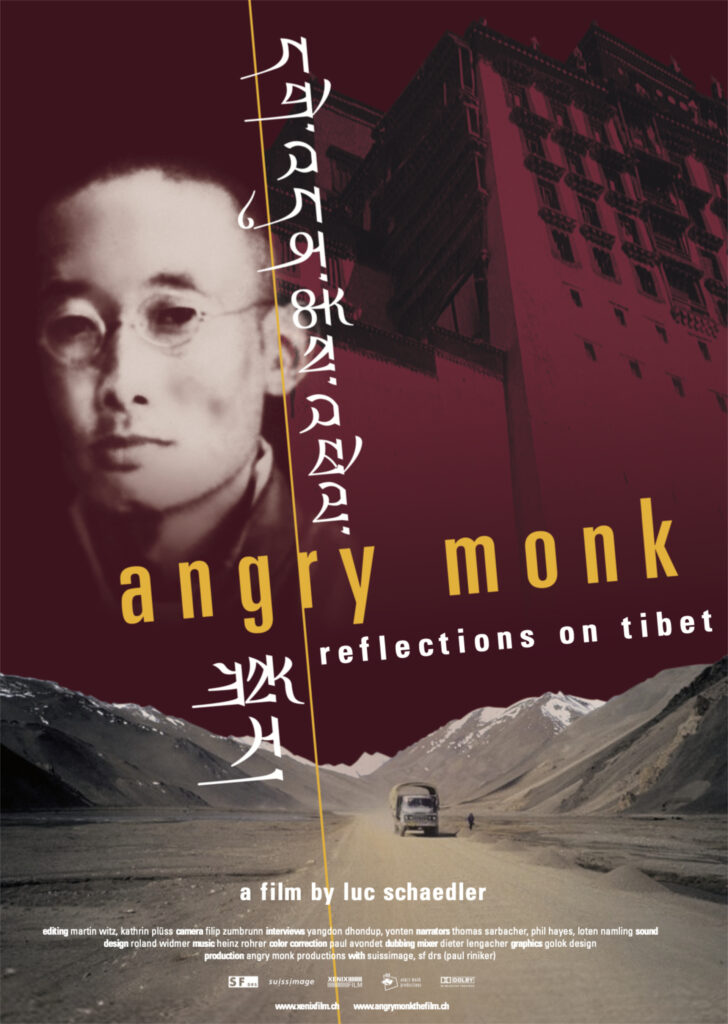
Angry Monk – Reflections on Tibet
FILM REVIEWS
ACADEMIC ARTICLES
DOCTORAL THESIS (PhD)
ABSTRACT
«Presentation of the sources and other materials»
The doctoral thesis consists of a visual and a written part – 1. the documentary film «Angry Monk – Reflections on Tibet» and 2. the almost integral presentation of the oral and written sources I worked with: the translated and/or transcribed interviews; excerpts from GC’s writings (in English translations, many for the first time); and a selection of writings and files about GC (namely from his Indian friends and the British secret service).
The aim of the written part is threefold: first and foremost, I see the following presentation as a contribution to the oral history, regarding the recent past of Tibet (1903–51), the biography of an important Tibetan individual (GC) and a reflection of the present situation in Tibet (and how it relates to the past). Second, I find it important to make my research materials accessible for further research, especially to critics of my work. Third, I would like to make my decision-making process more transparent by presenting the entirety of the research materials and by critically discussing my criteria for selection (interviews, texts of GC etc.).
An additional advantage of this kind of integral presentation of my research materials in digital form on CD-ROM is the fact that now they can be accessed easily, and thus encourage other scholars to actually use them and integrate them in their own works (copy/paste). Different than other visual works on DVD that come with ‘bonus features’ (e.g. ‘The Making of Dead Birds’ by Robert Gardner), is the fact that the bonus features (of which the present CD-ROM is an important part), is not yet another (pre-) selection by the director, but a more comprehensive sharing of the larger part of the research materials.
The discussion of one’s sources is certainly a neglected field in anthropology. Too often informants (especially in filmed interviews) are seen as ‘primary’ sources, when, in fact, they are not. They may be authentic sources (especially, when seen on film or heard on tape), but what they say is not necessarily true, or does not necessarily reflect what they actually think (Schlumpf, 1996; Jones, 1992). In the case of one of my interviewees, Horkhang Jampa Tendar, he told us more about what his father thought, than what he himself actually thinks. In his case, this might have several possible reasons, one of them certainly being the fact that – under Chinese rule in Tibet – it is safer for him to relate to us, what his father thought (past), than what he himself thinks (present). Furthermore, what some of the informants talk about is often influenced, not by what they actually know or witnessed themselves, but by certain topoi (themes). In the case of GC, there are several such themes: his debating skills, his provocative style, his curiosity, his drinking and smoking habit, his seeing prostitutes in India etc. In this sense, already my ‘primary’ sources are thus part of an ongoing construction of GC, which was only accelerated by my own film. Also, most of the old informants look back to a time, when Tibet lost its independence. Retrospectively, they all appear to be more critical with their own past, than they actually were at the time.
As for the translations that I had made from some of GC’s texts, there are similar problems, too. Since GC originally wrote them, they seem to be, not just authentic materials (of GC’s thinking, political views etc.), but primary sources in the true sense of the word. What has to be taken into account, though, is the following: the translations are not the original texts, but only translations (and in my case, ‘working’ translations, rather than ‘literary’ translations). Much of the quality, which can be found in the Tibetan original, is certainly lacking in the English translations. This goes, both for GC’s exquisite poetic style (personal communication of Tashi Tsering), as well as the content of his writings. What was ‘modern’ and thus astonishing and surprising for many Tibetans at the time (like GC claiming the world to be round and not flat) is just a common place today. Furthermore, the selection of the passages of GC’s writings that you will find below, were not made by GC himself, but by the director of the film (with the help of Tashi Tsering and others). They are in no way representative, as far as the full corpus of GC’s writings is concerned. They rather reflect, what I (and others) thought to be important for a film, which tried to place GC in a rather political and ‘social-rebel’ context. Luckily, there are some more accurate translations accessible; and hopefully more to come [See Lopez: ‘The Madman’s Middle Way’ (2006) and Huber: ‘The Guide to India’ (2000)].
The same obviously goes for the writings and files about GC. Far from being truthful and objective accounts, they tell us a lot about their creators. There is a considerable and easy to observe ‘added-value’ in their writings: e.g. the British Files are full of anti-communist rhetoric, whereas the accounts of two of his Indian friends (Mukherjee, Krishna) are full of ‘uncritical’ admiration for their Tibetan friend, who opened a world to them, when they traveled through Tibet in 1938.
Luc Schaedler